

Human Evolution and Climate Change
A Thought Experiment

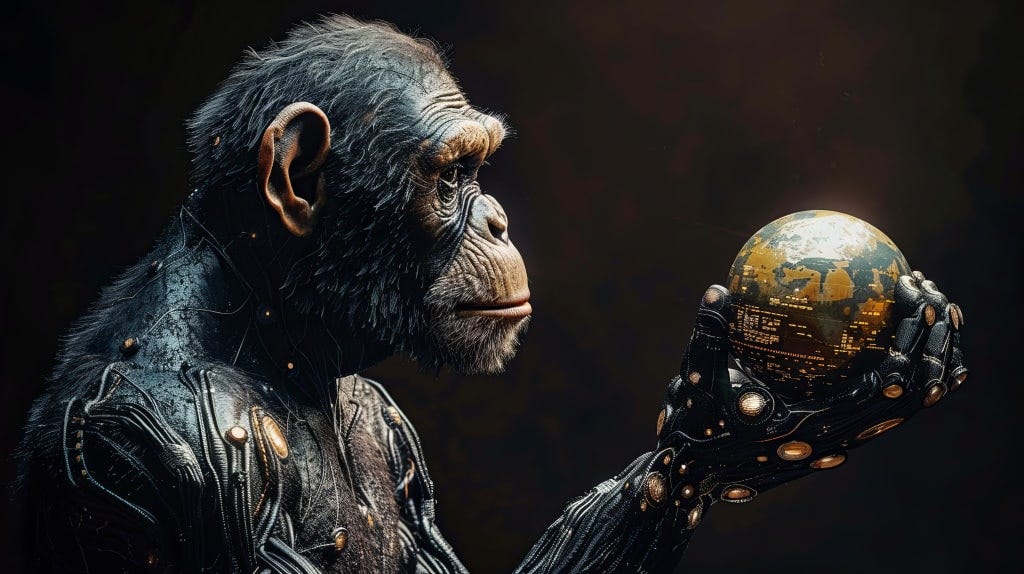
The Question
An oft asked question relates to how humans and every other species on the planet will or will not adapt to the new environmental conditions that climate change will quite probably (and arguably already has) impose across much of the globe. For other species the answer is fairly obvious, they will either adapt or they will perish. As has been the case throughout all of earth’s history, evolution through natural selection requires that those with the traits that are best adapted to reproduce will do so and so pass them on, especially when pressed by changes in the environment. Many argue that the changes we are seeing or will soon see as a result of climate change are occurring too rapidly for many species to adapt. In essence that evolution cannot keep up with the pace of change. Mutations simply cannot occur frequently enough to supply a wide enough variety of phenotypes of different varieties to allow for at least one that can survive the new conditions any given species may find itself in. Rapid changes are the hardest for the longest lived (excluding microorganisms), and slowest reproducing creatures to deal with, and they face the greatest threat of massive population decrease or even extinction. I happen to think that adaptation can happen much faster than is typically believed, but am not naïve enough to think that even a greatly accelerated adaptation or mutation process will be enough to save all or even most animal species from the threat of habitat loss or change brought about by global warming.
Modern humans and evolution by natural selection
Despite that excessively long prelude the goal of this piece is not to focus on the impacts of climate change on the non-human animals of the planet but rather to focus on us, the people of planet earth, how will we adapt?, How will we evolve? How will we be selected for? Many people would suggest these questions are irrelevant because they believe humans are no longer subject to the whims of evolution by natural selection. They argue that we slipped those chains long ago, possibly the moment we became conscious beings with intelligence enough to recognize ourselves as sentient existing individuals and form social bonds with others of our kind. In that moment or during that time we became smart enough to use our minds to “out-think” evolution or at least we had gained the potential to do so and eventually, with the help of technology we did. At some time in the past, exactly when is probably not knowable, evolution by natural selection ceased to apply to humans entirely, it was no longer of any consequence. If we were to continue to evolve it would only be through our own efforts, our own use of technology and our minds to change into whatever it is we desired and to do so at the pace of our choosing. Some might allow for a general exemption for natural selection by superficial categories such as looks (eye color preferences, hair color, general intelligence, wealth, etc.) but though natural yes they are still categories that are selected by choice and not imposed upon us by evolution’s dictate of survival of the fittest.
The impact of climate change
Climate change is an event of global magnitude that has the ability to impact the environment, the habitat, of possibly every human being living on the planet. If ever there were a force capable of selecting for the fittest humans this would seem to be it. Yet, it still seems unlikely, as we have the technology to adapt this threat, our species will not face extinction or even a major population reduction because of it. This is not to make excuses or suggest for a moment that it makes it OK. It is only to say that a threat as great as global climate change would seem to pale in comparison to our technological prowess and the power of our intelligence. (note: This entire paragraph is purely hypothetical and only for purposes of this post. I do not know if this is true and it is possible, probable even that it is not. This is an argument you will hear people make and make with conviction.)
The Thought Experiment - From an Alien's Point of View
Case closed right? Step back for a moment though and look at what is happening from an outsiders perspective, say an alien on another planet who does not know the difference between a human being and any other animal on this planet. The alien knows only that we are (probably) the highest population large animal on earth at just over 7 billion. It also knows about evolution by natural selection as we will assume for sake of this post that it is a law of nature that applies to all living beings anywhere in our universe. It also is aware of the major changes in earths climate that seem to be occurring more rapidly then has even been observed before in the planet’s history and it may even suspect or know that we are the cause of those accelerated changes. It also see our technology, but to the highly advanced alien our tech looks like a child’s toys or an animals playthings, cute perhaps and interesting maybe, but not very sophisticated and definitely not a sign of advanced intelligence. To the alien we are very much still at the mercy of evolution by natural selection. Then it sees us respond to climate change using our technology, it notices how we build levees, and pump water, and raise buildings. It watches us move millions of people using transport of every kind on the ground, through the air, on and below the seas even. It sees how we respond to climate change and continue to thrive. Our population is not reduced even as many other species are wiped out, in fact we continue to reproduce and grow at the same pace as ever.
Now we ask that alien what it has just observed, did the humans evolve and adapt, did natural selection apply to them? My bet is that it would say yes of course they did, it is obvious that this must be so. The fittest beings on the planet, the humans, were able to adapt to a massive change in their planets environmental conditions and continue to grow in population and pass on their genetic information to the next generation and the next and so forth.
In contrast many of species on the planet revealed their lack of fitness and so perished. It is fortunate for the humans that they have evolved a brain of limited, but still high enough capacity to allow them to engineer solutions to the problems hoisted upon them by the changing climate. They of course brought those problems on themselves which is just an illustration of their brain’s limited capacities. As to the question of evolution which is usually said to require some change in physical appearance or structure or function we do not consider such changes a necessity to say that a given species has evolved. The only requirement is that they survive to pass on their genetic material and they have. But looked at in another way they have changed and changed significantly. Physically they look the same, their bodies have the same structures, their brains are still of the same limited capacity, yet they have reorganized their social structures massively, and geographically their population distribution has undergone a significant shift. On a global scale the change in the total population in terms of physical location is the biggest we have yet observed.
I need to stress that none of what is written here should be read as in any way suggesting that climate change is not real, or is somehow not a threat, or that I believe we will be able to technology our way out of all the problems it will no doubt cause. It was simply a thought experiment to try and get a handle on the question of evolution and its applicability to the human species. In my view we are still very much in evolution’s grasp. Natural selection and survival of the fittest does very much still apply it is just that at the moment we happen to be the fittest. We are still forced to evolve as a species (if not as much or any as individuals thought that is still an open question) because of it. That may not always be true. After all those watchful aliens might pay us a visit some day.
I decided to engage with this thought experiment out of curiosity. I encourage anyone reading this to go ahead and actually read the essay.
I’m sharing my reflections for two reasons: I hope those with deeper expertise can challenge or expand my thinking. I wanted to approach the question from a humanities perspective, and to see how the lens of culture, behavior, and narrative might differ from the point of view of a science SME (something I am not).
The original conclusion asks: Did humans evolve and adapt? Did natural selection still apply?
The answer given is "yes" humans adapted, survived, and passed on their genes. Case closed.
But when I presented this to my imaginary alien, the response shifted. My alien would agree that humans are adaptable. But it would also point to other species, like tardigrades, which survive the vacuum of space, and the immortal jellyfish (Turritopsis dohrnii), which can revert to its juvenile state. These creatures don’t innovate. They endure. And eventually this will become a more influential conditional.
My alien would argue that culture only goes so far. That human intelligence, while impressive, may become a double-edged sword. We don’t mutate: when it gets cold, we manufacture coats from PET turned polyester, wasting water and releasing toxins and heat in the process. We solve problems by creating new ones. Eventually (my alien might predict), humans will distress the planet beyond repair. And when that happens, it won’t be the most intelligent species that survives. It’ll be the most physically pragmatic. The tardigrade. The smaller parasite outlasting the larger one.
We call it adaptation. My alien calls it survival of the fittest parasite.
PS: Kudos to roaches, rats and pigeons for their runner up placement. lol
Thoughts?